
Every investor makes mistakes. It’s part of the learning process. But some mistakes are so common and so costly that avoiding them can dramatically improve your long-term wealth creation. After analysing thousands of Indian retail investor portfolios and trading patterns, clear patterns emerge. Understanding these pitfalls before you encounter them can save you years of frustration and lakhs of rupees.
Table of Contents
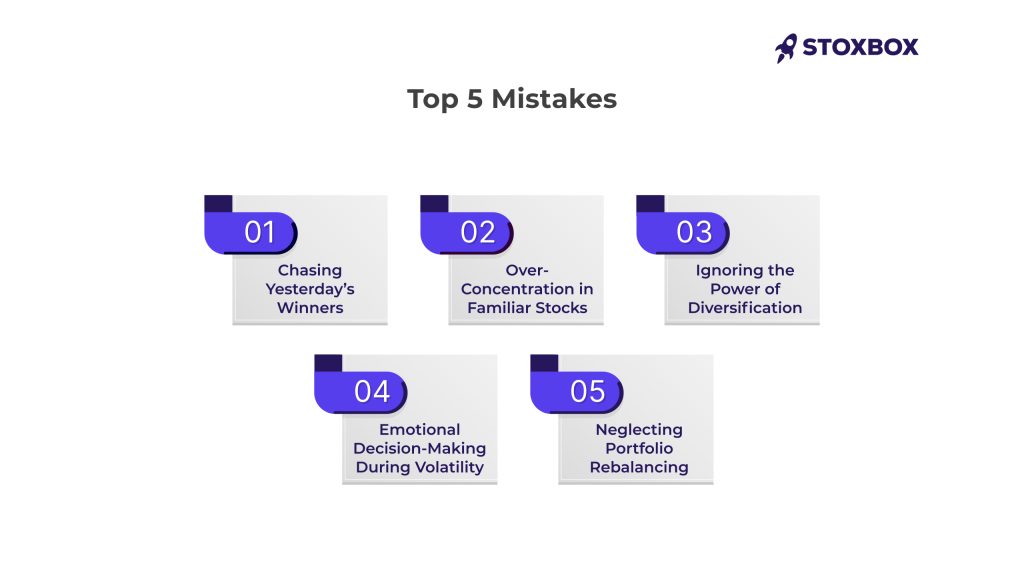
Mistake #1: Chasing Yesterday's Winners
Walk into any office cafeteria and you’ll hear it: “My colleague made 80% on that stock in six months!” The temptation to chase these spectacular returns is overwhelming. But here’s what the data shows: investors who chase past performance typically underperform those who invest systematically.
The Psychology Behind It: Humans are wired for pattern recognition. When we see a stock that’s surged 100% (hypothetically like some defence stocks in 2024-25), our brains convince us the trend will continue. We imagine getting in now and riding the next 100% surge. This is called recency bias, and it’s extraordinarily expensive.
What Actually Happens: By the time a stock’s performance makes headlines (hypothetically appearing in business news after 60-80% appreciation), much of the easy money has been made. Professional investors often use retail enthusiasm as an exit signal. Research on Indian markets shows that stocks experiencing extreme outperformance (hypothetically 80%+ in 6 months) tend to underperform the broader market over the subsequent 12-24 months.
Real Example: Consider the hypothetical case of IT stocks in early 2021. After surging 40-50% during the pandemic as digital transformation accelerated, retail investors piled in. Those who bought in January-March 2021 at peak valuations experienced flat to negative returns over the following 18 months as valuations normalised, while early investors who’d bought based on fundamentals in 2019-20 had already captured most gains.
The Smarter Approach: Instead of chasing individual stock momentum, consider thematic approaches that capture structural trends early. When a theme like defence modernisation or digital infrastructure is identified in its early stages (hypothetically 6-12 months before mainstream recognition), professionally constructed portfolios can participate in the entire theme’s development rather than trying to time individual stock entries.
This is where curated thematic baskets add value. Rather than buying defence stocks after they’ve made headlines (hypothetically after 50-70% appreciation), you participate in carefully researched themes when valuations are still reasonable (hypothetically when sector PE is 18-22x vs historical 20x average rather than 30-35x after the rally).
Action Steps:
- Resist the urge to invest based on recent performance alone
- Evaluate whether strong recent returns reflect fundamental strength or just momentum
- Consider if you’re late to a theme that’s already played out
- Look for emerging themes with strong fundamentals but modest recent appreciation
Mistake #2: Over-Concentration in Familiar Stocks
“I work in IT, so I understand tech companies.” “My uncle works at a PSU bank, so I invest there.” This familiarity bias causes investors to over-concentrate portfolios in sectors they know, creating dangerous concentration risk.
The Comfort Trap: Familiarity feels like expertise. If you work in pharmaceutical sales, pharma stocks feel safer because you understand the industry. But knowing an industry from an employee or customer perspective is very different from analysing it as an investor. More importantly, even if you do understand it well, concentration creates risk that diversification could mitigate.
The Hidden Cost: Over-concentration means your financial future becomes tied to one sector’s fortunes. Hypothetically, an IT professional with 60% of their equity portfolio in IT stocks faces double exposure: their salary and their investments both depend on the IT sector’s health. If IT faces a downturn (hypothetically experiencing a 25% decline during a slowdown), both income and portfolio suffer simultaneously.
Portfolio Reality Check: Review your holdings honestly. Do you have:
- More than 30% in a single sector?
- Multiple stocks in the same industry (hypothetically holding 4-5 PSU banks)?
- Heavy exposure to your employer’s sector?
If yes, you’re over-concentrated regardless of how well you understand those companies.
Real Numbers: Data from Indian brokerages shows that retail portfolios typically hold 5-8 stocks (hypothetical average), with 40-60% concentrated in just 2-3 sectors. In contrast, professional portfolios spread across 8-15 sectors to manage risk.
The Diversification Solution: True diversification means spreading investments across:
- Different sectors (IT, finance, consumer, infrastructure, energy)
- Market capitalizations (large, mid, and small caps)
- Investment themes (growth, value, dividend, thematic)
This doesn’t mean owning 50 random stocks. It means thoughtfully constructing a portfolio that won’t crater if one sector underperforms.
Professional basket approaches help here by ensuring proper diversification automatically. A well-constructed core basket might include 10-12 stocks across 8 different sectors (hypothetically 15% financials, 12% IT, 10% consumer, 10% healthcare, 10% energy, 10% materials, 8% industrials, 8% infrastructure, with remaining 17% across other sectors). This built-in diversification removes the burden of constructing balanced portfolios yourself.
For sector-specific views, thematic baskets let you take concentrated bets while maintaining overall portfolio balance. You might allocate 20-30% to a defence theme basket while keeping 70-80% diversified, rather than putting everything into defence stocks.
Stoxbox offers both diversified core baskets and thematic options, allowing you to balance stability with specific convictions.
Action Steps:
- Calculate your current sector concentration
- Identify if you have double exposure (career + investments in same sector)
- Plan to rebalance toward better diversification over 3-6 months
- Consider whether your stock selection reflects expertise or just familiarity
Mistake #3: Ignoring the Power of Diversification
StoxBasket transforms thematic investing from a complex research exercise into an accessible mobile experience:
Related to over-concentration but distinct, many investors simply don’t diversify enough, period. They might avoid their own sector but still hold only 3-4 stocks total, or invest exclusively in one type of company (only large caps, or only growth stocks, or only dividend payers).
The Single Stock Disaster: Every year, investors experience devastating losses from single stock concentration. Hypothetically, imagine putting ₹5 lakhs into a single mid-cap stock that looked promising. A management scandal, regulatory action, or sector downturn could erase 40-60% of value in weeks. That’s ₹2-3 lakhs gone, requiring subsequent 100%+ returns just to recover.
The Math of Diversification: Here’s what proper diversification achieves: If you hold 10 stocks with equal weight (10% each) and one suffers a catastrophic 50% decline, your portfolio drops just 5%. The same loss in a 3-stock portfolio (33% weight each) causes a 16.5% portfolio decline. This mathematical protection is invaluable.
Beyond Just Stock Count: True diversification considers multiple dimensions:
Sector Diversification: Don’t hold 10 stocks if 7 are banks. Spread across industries that respond differently to economic cycles.
Market Cap Diversification: Blend large caps (stability, hypothetically 30-40% of portfolio), mid caps (growth potential, hypothetically 40-50%), and select small caps (high growth, hypothetically 10-20%).
Style Diversification: Mix growth stocks (high earnings expansion), value stocks (trading below intrinsic worth), and income stocks (steady dividends).
Theme Diversification: Combine defensive themes (hypothetically PSU value stocks offering 5-6% dividends) with growth themes (hypothetically digital transformation or green energy).
Rebalancing for Diversification: Diversification isn’t a one-time action. As markets move, your allocation shifts. A stock that was 8% of your portfolio might grow to 18% after a strong run. You’ve now accidentally increased concentration. Regular rebalancing (hypothetically every 6-12 months) maintains your intended diversification.
This is where professionally managed baskets shine. They handle diversification complexity automatically:
- Initial Construction: Baskets are designed with proper sector weights (hypothetically ensuring no sector exceeds 25% and most sectors represented with 8-12%)
- Automatic Rebalancing: When stocks appreciate significantly (hypothetically growing from 8% to 16% of basket), the research team rebalances, trimming the position back to target weights
- Theme Blending: You can hold multiple baskets representing different themes, creating meta-diversification across strategies
Action Steps:
- Count your current holdings – aim for at least 8-10 stocks minimum
- Check sector distribution – no single sector should exceed 25-30%
- Evaluate market cap mix – avoid being 100% in any single cap category
- Plan rebalancing calendar – review and adjust allocation at least annually
Mistake #4: Emotional Decision-Making During Volatility
The market dropped 8% this week. Your portfolio is down ₹2 lakhs. Panic sets in. You sell everything, vowing to “get back in when things stabilise.” This emotional decision-making destroys wealth faster than almost anything else.
The Emotional Cycle: Investor emotions follow predictable patterns:
- Euphoria: “The market’s up 20% this year, I should invest more!” (buying at peaks)
- Anxiety: “It’s down 5% in a week, maybe I should reduce exposure” (selling during normal corrections)
- Panic: “It’s crashed 15%, I need to get out before losing everything!” (capitulating at bottoms)
- Relief: “It’s finally recovering, but I’ll wait for more stability” (missing the bounce)
- Regret: “I should have stayed invested” (repeating the cycle)
The Numbers: Research shows the cost of emotional exits. Hypothetically, if you’d invested ₹10 lakhs in Nifty in January 2020 and held through the COVID crash (March 2020 dropped 38% from peaks), subsequent recovery, and growth through March 2026, you’d have approximately ₹21 lakhs (hypothetical, representing ~13% CAGR).
But if you panicked in March 2020, sold at the bottom (hypothetically losing 35%), and waited until October 2020 to re-enter (missing the initial sharp recovery of 50%+ from lows), you’d have only ₹14 lakhs (hypothetical, representing ~5% CAGR). That emotional decision cost you ₹7 lakhs.
Why We Make Emotional Decisions: Loss aversion is a powerful psychological force. Research shows that the pain of losing ₹1,000 is approximately twice as intense as the pleasure of gaining ₹1,000. When markets drop, this pain drives irrational decisions.
Additionally, volatility feels personally threatening even when it’s statistically normal. A 10% market correction (hypothetically occurring once every 12-18 months on average) triggers the same fear response as genuine crises, causing investors to confuse noise with signal.
The Professional Advantage: Professional investors succeed partly because they follow systematic processes that override emotions. They have:
- Pre-defined entry and exit criteria: Decisions made based on valuations and fundamentals, not fear
- Rebalancing discipline: Adding to positions during corrections rather than fleeing
- Time horizon clarity: Investing with 3-5 year views, making monthly volatility irrelevant
How Baskets Help with Emotional Discipline: Professionally managed baskets provide emotional scaffolding:
Expert Oversight: When your portfolio drops 12% (hypothetically during a market correction), you receive context from research analysts explaining whether this is normal volatility or genuine concern. This professional perspective prevents panic.
Systematic Rebalancing: Rather than you deciding whether to sell or hold during turbulence, the research team makes systematic decisions based on fundamentals. If their analysis says “temporary dip, maintain holdings,” you’re not tempted to override that with emotion.
Defined Horizons: Each basket comes with an expected investment timeline (hypothetically 3-5 years). This clarity helps you weather 3-6 month volatility periods without panic, knowing you’re investing for the longer term.
Exit Discipline: You don’t have to decide when to sell. When baskets reach targets or the thesis changes (hypothetically after 18-22% gains over target period), you receive exit recommendations, removing the emotional burden of those decisions.
Get professional guidance during volatile periods through Stoxcalls, helping you separate noise from genuine signals.
Action Steps:
- Write down your investment horizon before volatility strikes
- Create a rule: never make investment decisions on high-emotion days
- Review past emotional decisions and their costs to learn from experience
- Consider systematic approaches that reduce the burden of emotional decisions
Mistake #5: Neglecting Portfolio Rebalancing
You built a well-diversified portfolio two years ago. But you haven’t touched it since. Without realising it, your carefully balanced allocation has completely shifted, creating risks you didn’t intend.
The Drift Problem: Markets don’t move uniformly. Over time, strong performers grow to oversized positions while weak performers shrink. Hypothetically:
- Initial portfolio (₹5 lakhs): 10 stocks, each 10% (₹50,000)
- After 18 months: Top performer surged 60% (now ₹80,000, 18% of portfolio), bottom performer dropped 30% (now ₹35,000, 6% of portfolio)
- Result: Your intended 10% equal weight has drifted to concentrated 18% in one stock and underweight 6% in another
This drift happens gradually, making it invisible until it’s significant.
Why Rebalancing Matters: Rebalancing serves multiple purposes:
Risk Control: Trimming oversized positions prevents excessive concentration. That stock now representing 20% of your portfolio might be due for correction.
Enforcing Discipline: Rebalancing forces “buy low, sell high” behaviour. You sell portions of winners (selling high) and add to underperformers or new opportunities (buying low). This is psychologically difficult but mathematically beneficial.
Opportunity Capture: As themes evolve, rebalancing lets you shift from played-out opportunities to emerging ones. Hypothetically, if infrastructure stocks have run their course while defence offers new opportunities, rebalancing facilitates that shift.
Performance Enhancement: Studies show that disciplined rebalancing can add 0.5-1.5% to annual returns (hypothetically) over long periods, simply by maintaining target allocations and forcing contrarian discipline.
The Rebalancing Challenge for DIY Investors: Most retail investors don’t rebalance because:
- Time consuming: Reviewing portfolio, calculating new weights, deciding what to buy/sell takes hours
- Transaction costs: Multiple buy and sell orders incur brokerage charges
- Tax considerations: Selling winners triggers capital gains taxes
- Emotional difficulty: Selling winners and buying underperformers feels wrong psychologically
- Complexity: Deciding optimal new weights requires analysis
Result? Less than 20% of retail investors rebalance even once annually (hypothetical estimate).
The Automated Solution: Professionally managed baskets make rebalancing systematic and automatic:
Continuous Monitoring: Research teams track every holding daily, identifying when rebalancing adds value (hypothetically when stock reaches 95% of target, when portfolio weights drift beyond 2-3% from target, or when new opportunities emerge).
Expertise Applied: Decisions about what to trim and what to add leverage professional analysis of valuations, technicals, and fundamentals rather than your guesswork.
Execution Handled: When rebalancing is needed, you simply approve. The platform handles all transactions (hypothetically coordinating 4-8 simultaneous sell and buy orders) in a single session.
Tax Efficiency: While rebalancing triggers taxable events, professional management optimises timing (hypothetically prioritising rebalancing in January-February to use the annual ₹1 lakh LTCG exemption if available).
Cost Justification: The modest transaction costs (hypothetically ₹100-200 in brokerage for a typical rebalancing) are outweighed by the performance benefits and risk reduction (hypothetically preventing 5-10% losses from over-concentration).
Stay informed about rebalancing needs through Stoxbox’s whatsapp notifications, ensuring you act on timely recommendations.
Action Steps:
- Review your portfolio’s current weights vs. your initial plan
- Calculate how much drift has occurred (many investors are shocked)
- Set a calendar reminder to review allocation quarterly
- Consider systematic approaches that rebalance automatically
Building Better Investment Habits
Avoiding these five mistakes isn’t about perfection; it’s about building better systems and processes. Here’s how to implement what you’ve learned:
Create an Investment Policy Statement: Write down your investment rules before emotions run high:
- Target asset allocation (hypothetically 60% equity, 40% debt)
- Within equity, sector limits (hypothetically no sector over 25%)
- Rebalancing triggers (hypothetically rebalance when any position drifts 5%+ from target)
- Holding periods (hypothetically minimum 3-year horizon for equity)
Build Systematic Approaches: Replace ad-hoc decisions with systems:
- SIPs for regular investing: Removes timing decisions
- Automatic rebalancing: Through professional management or disciplined calendar
- Thematic allocation: Instead of chasing individual stocks, invest in professionally curated themes
Leverage Professional Expertise: You don’t need to be a full-time investor to achieve good returns. Professional research, systematic rebalancing, and expert oversight can be accessed through modern investment products designed for retail investors.
Whether through mutual funds, PMS (for larger portfolios), or curated equity baskets, the key is finding approaches that remove the burden of constant decision-making while maintaining transparency and control.
Monitor Without Obsessing: Check your portfolio periodically (hypothetically monthly for awareness, quarterly for decisions) rather than daily. Frequent checking increases the likelihood of emotional reactions to normal volatility.
Keep Learning: Investment mistakes teach valuable lessons. Review your decisions regularly:
- What worked and why?
- What didn’t work and why?
- What would you do differently?
This reflection builds judgment over time.
Frequently Asked Questions
How do I know if I'm chasing performance or making a smart investment? Ask yourself: "Would I invest in this if it had been flat for the past year?"
If the answer is no, you’re likely chasing performance. Smart investments are based on future potential at current valuations, not past returns. Additionally, check if the stock has appreciated more than 50% in the past 6-12 months (hypothetically) – this often signals you’re late to the opportunity. Finally, evaluate whether you understand why it went up and if those drivers will continue, or if you’re just extrapolating past trends.
What's the ideal number of stocks to hold for proper diversification?
Research suggests 8-15 stocks provide most diversification benefits (hypothetically capturing 85-90% of the risk reduction that full diversification offers). Below 8 stocks, you’re likely under-diversified and vulnerable to individual stock risk. Above 20 stocks, you’re probably over-diversified and may struggle to track all holdings effectively. The exact number depends on market cap (larger caps need fewer stocks, small caps need more) and sector spread (ensure 8-12 holdings spread across at least 6-8 different sectors).
How often should I rebalance my portfolio?
Most professional guidance suggests quarterly reviews with annual rebalancing, or rebalancing whenever any position drifts more than 5% from target weights (hypothetically). However, avoid excessive rebalancing (monthly) which generates unnecessary costs and taxes. The optimal frequency balances maintaining allocation discipline with minimising transaction costs and tax impacts. Many investors find semi-annual rebalancing (hypothetically in January and July) strikes this balance well.
Is it possible to diversify too much?
Yes. Over-diversification (hypothetically owning 30-40+ stocks in a retail portfolio) creates several problems: difficulty tracking all holdings, minimal impact of any single good decision, excessive transaction costs, and reduced performance compared to a focused, well-diversified portfolio. Studies suggest returns plateau after 15-20 stocks (hypothetically) while monitoring complexity continues rising. Better to own 10-12 high-conviction, well-researched stocks than 35 random holdings.
How do I overcome emotional decisions during market crashes?
Create pre-commitment mechanisms: write rules before volatility strikes (hypothetically “I will not sell unless fundamentals change, regardless of price movement”), set up systematic investments (SIPs that continue regardless of market levels), work with professional management that provides perspective during downturns, avoid checking portfolio daily during volatile periods (hypothetically limit to weekly reviews), and keep emergency funds so market drops don’t force liquidation. Most importantly, remember that every market crash in history (hypothetically 12+ significant corrections over past 30 years in Indian markets) has eventually recovered to new highs.
Are professional portfolio management solutions worth the cost?
Compare the costs to benefits: Professional management typically involves brokerage costs plus potentially small additional fees (hypothetically 0.5-1% annually for basket approaches vs 1.5-2.5% for mutual funds). Benefits include systematic rebalancing (hypothetically adding 0.5-1% annually through disciplined trading), avoiding emotional mistakes (hypothetically saving 2-5% by preventing panic selling), accessing professional research (reducing individual stock risk), and time savings (hypothetically 3-5 hours monthly). For most investors, professional approaches deliver value significantly exceeding costs, particularly when accounting for mistake avoidance.
Your Wealth-Building Journey Starts Here