
Remember when everyone wished they’d invested in IT stocks before the tech boom? Or defence stocks before recent government initiatives? These massive sectoral opportunities create life-changing wealth for those who identify them early. But here’s the problem: knowing a sector will grow is different from knowing which specific companies within that sector will succeed. This is where thematic investing through StoxBasket changes everything.
Table of Contents
Catching the Next Big Trend
India’s defence sector surged following increased government spending and indigenisation policies. Companies like Hindustan Aeronautics, Bharat Electronics, and Mazagon Dock delivered extraordinary returns (hypothetically 60-120% over 24 months from early 2023 to early 2025) to investors who participated early.
Similarly, the PSU reformation theme, green energy transition, digital India infrastructure, and financial inclusion have created sector-wide momentum that lifted multiple stocks simultaneously (hypothetically PSU banking stocks delivering average returns of 45% in 2024-25).
The challenge? By the time these themes become obvious to everyone (hypothetically appearing in mainstream media headlines), much of the gain has already happened (hypothetically 40-60% of the eventual move). Early identification is crucial. But even when you identify a theme correctly, selecting the right stocks within that theme requires deep expertise.
Consider the defence opportunity. Would you have known that Bharat Dynamics’ missile systems would outperform (hypothetically delivering 85% returns)? Or that Data Patterns’ avionics business would capture significant export opportunities (hypothetically growing revenues 120% year-over-year)? Probably not without extensive industry research.
This is precisely the problem thematic investing through StoxBasket solves: it lets you participate in high-conviction themes through professionally constructed portfolios without requiring you to pick individual winners.
What is Thematic Investing?
Thematic investing means building portfolios around specific investment themes, trends, or sectors rather than broad market exposure or individual stock selection.
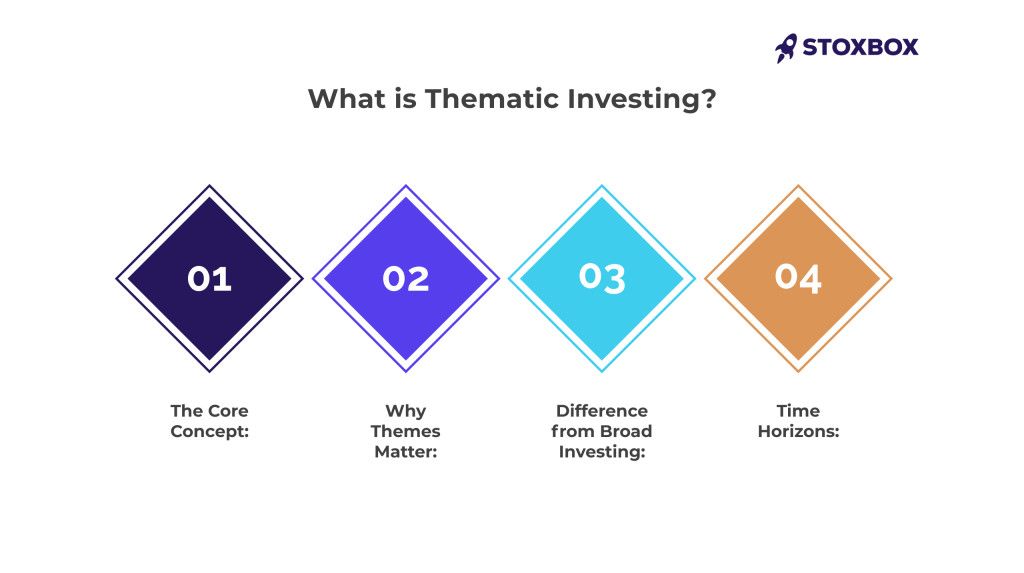
The Core Concept:
Instead of buying a general index fund or random individual stocks, you invest in a focused portfolio capitalising on a specific trend you believe will drive growth. This might be a sectoral theme (like healthcare or infrastructure), a strategic theme (like defence modernisation or energy transition), or a structural theme (like digital payments or electric mobility).
Why Themes Matter:
Modern markets are increasingly driven by powerful structural trends. Government policies (hypothetically allocating ₹10 lakh crore to infrastructure over 5 years), technological shifts, demographic changes, and global developments create multi-year tailwinds for specific sectors. Companies benefiting from these tailwinds often outperform broader markets significantly (hypothetically thematic baskets delivering 18-25% annually vs Nifty’s 12-15%).
Difference from Broad Investing:
A Nifty 50 index fund gives you exposure to 50 large companies across all sectors. A thematic basket gives you concentrated exposure to 8-12 carefully selected companies within a single high-conviction theme. This concentration drives potentially higher returns when the theme plays out (hypothetically delivering 1.5-2x the returns of broad indices), though it also means higher risk if the theme underperforms.
Time Horizons:
Thematic investments typically require 3-5 year horizons for themes to fully materialise. Short-term volatility is common (hypothetically 15-25% drawdowns even in successful themes) as markets take time to recognise and price in structural opportunities.
How StoxBasket Enables Thematic Participation
StoxBasket transforms thematic investing from a complex research exercise into an accessible mobile experience:
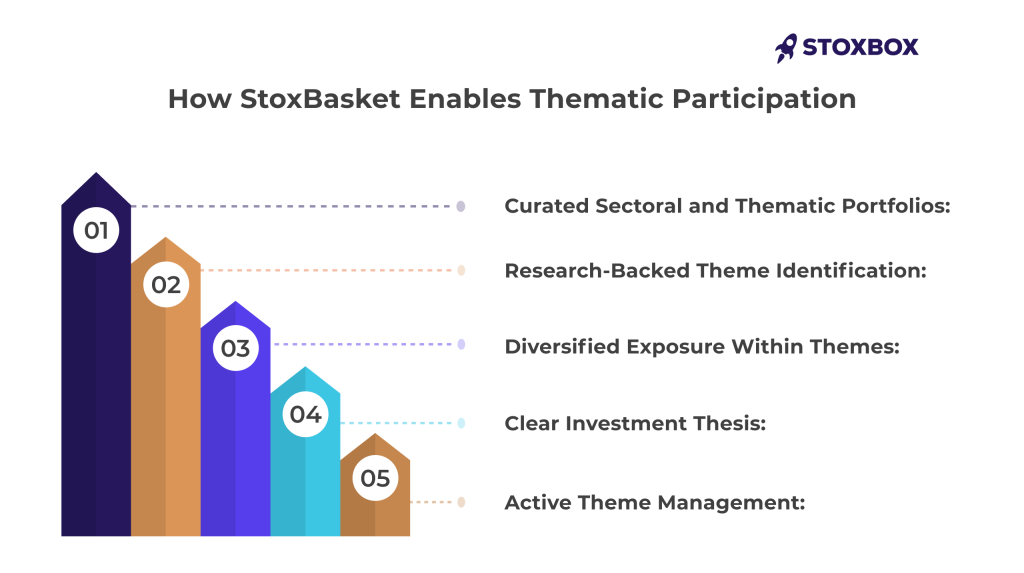
Curated Sectoral and Thematic Portfolios:
The research team identifies high-conviction themes based on government policies (hypothetically tracking Union Budget allocations, ministry announcements, and policy initiatives), structural economic trends, technological disruptions, and global developments. Each theme becomes a carefully constructed basket of stocks positioned to benefit.
Research-Backed Theme Identification:
Unlike retail investors who often chase themes after media coverage (hypothetically entering themes 12-18 months after institutional investors), professional analysts identify themes early. They assess policy announcements, budget allocations (hypothetically analysing ₹48 lakh crore Union Budget for sectoral priorities), regulatory changes, and industry developments to spot opportunities before they become consensus.
Diversified Exposure Within Themes:
Each thematic basket contains 8-12 stocks (hypothetical) rather than betting on a single company. This captures the theme’s upside while reducing individual stock risk. If you believe in defence growth, you don’t have to guess whether HAL or BEL will perform better; you own both alongside other defence players (hypothetically spreading ₹30,000 investment across 10 defence stocks at ₹3,000 each).
Clear Investment Thesis:
Every basket comes with a detailed strategy document explaining why this theme matters, what specific catalysts support it (hypothetically listing 5-8 key catalysts like government orders, export opportunities, technology partnerships), which companies were selected and why, what risks exist (hypothetically identifying 3-5 key risk factors), and what timeframe is expected for the theme to play out.
Active Theme Management:
Themes evolve. Government priorities shift. New companies emerge while others lose relevance. The research team actively manages thematic baskets (hypothetically reviewing holdings monthly), adding new opportunities (hypothetically when new companies list or existing ones demonstrate superior execution) and trimming positions as the theme develops.
StoxCalls provides deep thematic research helping you understand the macro trends driving each basket’s strategy and potential returns. recommended for any of your baskets, ensuring you never miss important portfolio optimisation opportunities.
Popular Thematic Baskets and Their Rationale
While specific baskets available change over time, here are examples of thematic investment opportunities StoxBasket might offer (hypothetical as of March 2026):
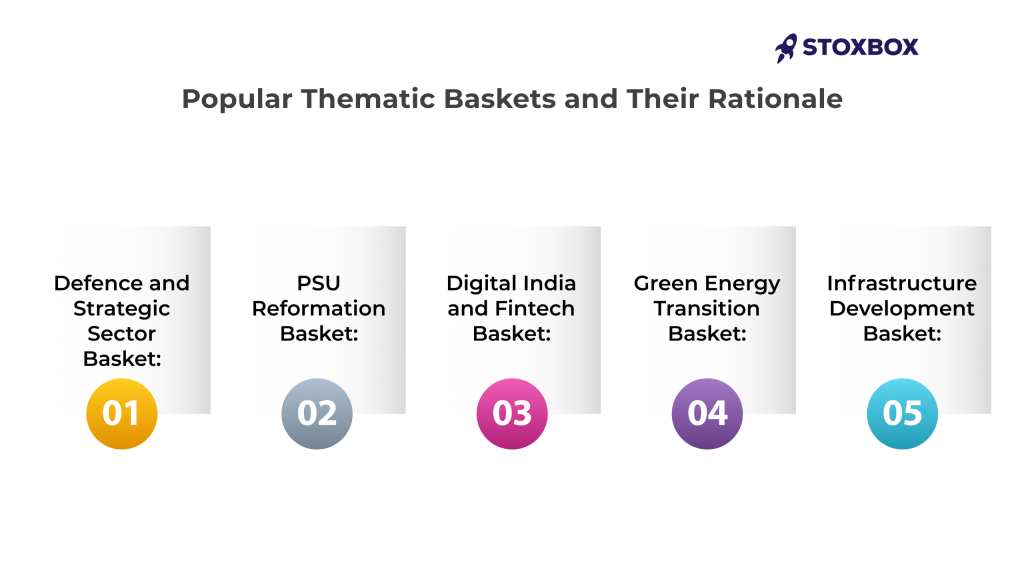
Defence and Strategic Sector Basket:
Theme: India’s push for defence indigenisation and increased military spending creates multi-year opportunities for domestic manufacturers.
Rationale: Government’s Atmanirbhar Bharat in defence targeting 75% indigenous content by 2027, rising defence budget allocations (hypothetically ₹6.8 lakh crore for FY2026-27, up 12% YoY), export potential for Indian systems (hypothetically targeting ₹35,000 crore exports by 2028), and replacement of ageing equipment (hypothetically ₹3.5 lakh crore modernisation pipeline over 5 years).
Holdings Might Include: Aerospace manufacturers, electronics and radar systems companies, naval shipbuilders, missile system producers, and defence components suppliers.
Expected Returns: Hypothetically targeting 18-22% annually over 3-5 years.
Minimum Investment: Hypothetically ₹30,000
PSU Reformation Basket:
Theme: Government-owned enterprises undergoing strategic disinvestment and operational reforms offer value opportunities.
Rationale: Disinvestment programme unlocking value (hypothetically targeting ₹1.2 lakh crore disinvestment in FY2026-27), professional management improving efficiency (hypothetically ROE improvement from 8% to 14% over 3 years), and undervalued assets in strategic sectors (hypothetically trading at 0.8x book value vs private peers at 2.5x).
Holdings Might Include: Banks undergoing consolidation, energy sector PSUs with strong dividends (hypothetically 5-7% dividend yields), infrastructure PSUs with government project pipelines, and manufacturing PSUs improving margins.
Expected Returns: Hypothetically targeting 15-20% annually over 3-5 years.
Minimum Investment: Hypothetically ₹25,000
Digital India and Fintech Basket:
Theme: India’s digital infrastructure expansion and financial technology adoption creates opportunities across the ecosystem.
Rationale: UPI and digital payments growth (hypothetically UPI transactions reaching 15 billion monthly by 2026), government’s Digital India mission allocations (hypothetically ₹25,000 crore over 3 years), increasing internet penetration in tier-2/3 cities (hypothetically reaching 65% penetration by 2027), and cloud adoption by enterprises (hypothetically growing 28% annually).
Holdings Might Include: Payment infrastructure providers, IT services with digital focus, cloud and data centre operators, and cybersecurity companies.
Expected Returns: Hypothetically targeting 20-25% annually over 4-7 years.
Minimum Investment: Hypothetically ₹35,000
Green Energy Transition Basket:
Theme: India’s commitment to renewable energy targets creates opportunities in solar, wind, and enabling infrastructure.
Rationale: Government’s renewable capacity targets (hypothetically 550 GW by 2030), falling solar costs making renewables competitive (hypothetically solar LCOE at ₹2.2/kWh vs coal at ₹3.5/kWh), global ESG focus driving capital to green projects (hypothetically $150 billion green financing over 5 years), and green hydrogen infrastructure opportunity (hypothetically 5 million tonnes annual production by 2030).
Holdings Might Include: Solar equipment manufacturers, wind turbine producers, renewable project developers, and green hydrogen infrastructure players.
Expected Returns: Hypothetically targeting 16-20% annually over 5-7 years.
Minimum Investment: Hypothetically ₹40,000
Infrastructure Development Basket:
Theme: Government’s infrastructure spending push benefits construction, materials, and engineering companies.
Rationale: National Infrastructure Pipeline allocations (hypothetically ₹140 lakh crore over 5 years), highway and metro expansion programmes (hypothetically 50,000 km highway addition by 2028), housing and urban development initiatives (hypothetically 2 crore affordable homes by 2027), and capital goods modernisation (hypothetically ₹2 lakh crore annual capex by industry).
Holdings Might Include: Construction and engineering firms, cement and building materials, infrastructure financing companies, and capital goods manufacturers.
Expected Returns: Hypothetically targeting 17-21% annually over 3-5 years.
Minimum Investment: Hypothetically ₹28,000
Each thematic basket represents a researched view on which sectors will outperform and which specific companies within those sectors are best positioned.
The Advantage of Professional Theme Selection
What makes professionally managed thematic baskets superior to self-directed thematic investing?
Early Identification:
Research analysts track policy developments, budget allocations, and industry trends full-time. They identify themes in early stages before retail awareness drives valuations higher (hypothetically identifying themes when stocks trade at 12-15x PE vs 22-25x when themes become mainstream).
Avoiding Hype-Driven Mistakes:
By the time a theme appears in mainstream media, it’s often partially played out (hypothetically 50-70% of the move completed). Professional theme selection distinguishes between genuine structural opportunities (hypothetically with 5-10 year runways) and temporary market narratives (hypothetically 6-12 month hype cycles).
Company-Level Diligence:
Identifying a theme is step one. Step two requires evaluating dozens of companies (hypothetically reviewing 40-50 companies per theme) to determine which have the best competitive advantages, management quality (hypothetically assessing management track record over 5+ years), financial strength (hypothetically debt-to-equity below 0.8), execution capability (hypothetically consistent 15%+ revenue growth), and valuation within that theme.
Portfolio Construction Expertise:
How many stocks should a thematic basket contain? What weight should each receive? Should you include large caps for stability or mid caps for growth? These decisions significantly impact returns and risk (hypothetically 10-stock baskets delivering 18% returns vs 5-stock baskets delivering 22% but with 30% higher volatility).
Risk Management:
Thematic concentration creates risk. Professional baskets incorporate risk management through careful position sizing (hypothetically no single stock exceeding 15-18% of basket), quality criteria (hypothetically minimum market cap of ₹5,000 crore), and diversification within themes to balance upside potential with downside protection.
Timing and Patience:
Themes take years to play out (hypothetically defence theme requiring 4-5 years for full order book conversion). Professional management maintains conviction through volatility (hypothetically holding through 20-25% corrections), adding to positions during corrections rather than panicking. This discipline is difficult for individual investors to maintain.
Exit Timing:
Knowing when a theme has played out is as important as identifying it initially. Research teams monitor valuation expansion (hypothetically exiting when PE multiples reach 1.8-2x sector averages), policy changes (hypothetically tracking budget allocation shifts), and market positioning (hypothetically when institutional ownership exceeds 65%) to recommend exits at appropriate times.
How to Choose the Right Thematic Basket
With multiple thematic options available (hypothetically 8-12 active thematic baskets at any time), how do you select baskets aligned with your goals?
Understand Your Investment Horizon:
Match basket themes to your timeframe. Infrastructure baskets tied to multi-year government programmes suit 3-5 year horizons (hypothetically aligned with National Infrastructure Pipeline till 2030). Emerging technology themes might require 5-7 years (hypothetically for full digital transformation adoption). Ensure you can stay invested for the theme’s expected duration.
Assess Your Risk Tolerance:
Some themes (like established sector rotations) carry moderate risk (hypothetically 15-20% volatility). Others (like emerging technologies or policy-dependent themes) are higher risk (hypothetically 25-35% volatility). Choose themes where you can tolerate potential volatility (hypothetically being comfortable with ₹30,000 investment fluctuating between ₹25,000-₹38,000) without panic selling.
Evaluate Conviction Level:
Invest in themes you actually believe in. If you’re sceptical about renewable energy’s viability, don’t invest in a green energy basket regardless of performance projections. Conviction helps you stay invested during inevitable corrections (hypothetically holding through 20% drawdowns that occur even in successful themes).
Portfolio Allocation Guidelines:
Thematic baskets should typically represent 20-40% of your equity portfolio (hypothetically if you have ₹2 lakh in equities, allocate ₹40,000-80,000 to thematic baskets), with the remainder in diversified holdings. Within thematic allocation, consider spreading across 2-3 uncorrelated themes (hypothetically combining defensive PSU basket with growth-oriented digital basket) rather than concentrating in one.
Avoid Overlap:
If you already own defence stocks individually (hypothetically holding HAL and BEL worth ₹20,000), adding a defence basket creates over-concentration (hypothetically increasing defence exposure to 25-30% of portfolio). Review existing holdings before selecting thematic baskets to ensure appropriate diversification.
Consider Complementary Themes:
Some investors combine a defensive theme (like PSU dividend payers hypothetically yielding 6-7%) with a growth theme (like digital infrastructure hypothetically targeting 22-25% returns) to balance stability and upside potential.
Review Strategy Documents:
Every basket includes detailed strategy explanations. Read these carefully to understand the investment thesis, risks (hypothetically policy reversal risk, execution delays, valuation risks), and expected catalysts (hypothetically specific government orders, export contracts, technology launches) before investing.
Use StoxBox‘s investment calculators to determine appropriate thematic allocation within your overall portfolio based on your risk profile and goals.
Monitoring and Managing Thematic Investments
Once invested in thematic baskets, ongoing management requires attention but remains straightforward:
Performance Tracking vs. Benchmark:
Each basket displays performance relative to Nifty and its own benchmark. Thematic baskets may underperform broad markets during some periods while outperforming during others (hypothetically defence basket underperforming Nifty by 5% in Year 1 but outperforming by 12% in Year 2). Evaluate performance over the theme’s expected horizon (hypothetically 3-5 years), not monthly.
Understanding Volatility:
Thematic concentration means higher volatility than diversified portfolios. Defence stocks might surge 20% one month and correct 10% the next (hypothetically HAL moving from ₹3,500 to ₹4,200 in January then to ₹3,800 in February). This volatility is normal for thematic investing (hypothetically 22-28% annual volatility vs 15-18% for Nifty). Focus on long-term trajectory rather than short-term fluctuations.
Rebalancing Within Themes:
The research team actively manages thematic baskets, rebalancing as opportunities within the theme evolve (hypothetically 1-2 times annually). You might receive notifications that certain stocks are being trimmed (hypothetically selling Stock A after 45% appreciation) while others are added (hypothetically adding Stock B trading 18% below intrinsic value), all maintaining the core theme exposure.
Exit Signals:
Theme-based exits occur when target returns are achieved (hypothetically basket delivering 68% over 3.5 years, meeting the 18% annual target), policy environment changes (hypothetically government reducing infrastructure spending by 20%), or valuation expansion (hypothetically stocks pricing in 95% of 5-year growth expectations). The research team monitors these factors and recommends exits appropriately.
Tax Implications:
Thematic baskets with higher turnover during rebalancing generate more taxable events. Be aware of capital gains implications (hypothetically LTCG of 10% on gains above ₹1 lakh annually, STCG of 15%) and consider holding periods when evaluating themes. Long-term capital gains treatment (holding beyond one year) offers tax advantages.
News and Catalysts:
Stay informed about developments affecting your themes. Budget announcements (hypothetically Union Budget in February highlighting sector allocations), policy changes, and industry news provide context for basket performance. StoxBot can alert you to significant theme-related developments (hypothetically major defence order wins, infrastructure project approvals).
Get real-time alerts about rebalancing, exits, and major theme developments through StoxBot on WhatsApp, keeping you informed without requiring constant monitoring.
Real Success Story: Defence Basket Performance
While past performance doesn’t guarantee future results, examining how thematic baskets capture opportunities illustrates their value (hypothetical example based on market trends):
Hypothetical Defence Basket Launch (January 2023):
As government announced enhanced defence indigenisation targets (hypothetically 75% indigenous content by 2027) and increased budget allocations (hypothetically 13% YoY increase to ₹5.9 lakh crore), a Defence and Strategic Sector basket launched with this thesis: “Multi-year defence modernisation (hypothetically ₹3.2 lakh crore equipment pipeline over 5 years) and indigenisation create sustained demand for domestic manufacturers with strong order books (hypothetically ₹2.8 lakh crore combined for top 5 companies) and export potential (hypothetically targeting ₹25,000 crore exports by 2025).”
Initial Composition (₹30,000 investment):
The basket included:
HAL (20% – ₹6,000)
BEL (18% – ₹5,400)
Mazagon Dock (15% – ₹4,500)
Bharat Dynamics (15% – ₹4,500)
Data Patterns (12% – ₹3,600)
Solar Industries (10% – ₹3,000)
MTAR Technologies (10% – ₹3,000)
Theme Development (2023-2024):
Over 18 months, several catalysts materialised including major aircraft orders (hypothetically ₹48,000 crore Tejas orders), submarine contracts (hypothetically ₹42,000 crore Project 75I), defence export achievements (hypothetically ₹21,000 crore exports in FY2024, exceeding targets), and successful demonstration of indigenous systems creating international interest (hypothetically BrahMos export orders worth ₹8,500 crore).
Performance Highlights:
The basket captured this theme’s momentum through multiple components:
Some positions delivered exceptional returns (hypothetically Data Patterns: +82%, BEL: +68% as order books expanded)
Others provided steady gains (hypothetically HAL: +45%, Mazagon: +38% on consistent execution)
Importantly, the basket’s diversification protected against individual stock disappointments (hypothetically one holding declining 8% due to project delays, but representing only 10% of portfolio, limiting impact to 0.8% of total basket)
Overall basket value grew from ₹30,000 to ₹48,600 (hypothetical), representing 62% total return over 18 months or approximately 35% annualised
Rebalancing Actions:
As certain stocks reached near-term targets (hypothetically Data Patterns hitting ₹950 vs ₹1,000 target in July 2024), the research team rebalanced, booking partial profits (hypothetically selling 50% of Data Patterns position at ₹950, realising ₹2,950 from initial ₹3,600 investment) and redeploying into emerging opportunities within the defence ecosystem (hypothetically adding Garden Reach Shipbuilders at attractive valuations with 22x PE vs sector average of 28x). This active management enhanced returns beyond buy-and-hold (hypothetically adding 5-7 percentage points to overall basket return).
Exit Recommendation (Hypothetical March 2026):
After significant appreciation (hypothetically basket reaching ₹52,800, up 76% from initial ₹30,000) and as valuations expanded to reflect much of the near-term opportunity (hypothetically sector PE reaching 32x vs historical average of 22x, suggesting limited further multiple expansion), an exit was recommended. Investors who acted captured substantial gains (hypothetically realising 76% gain over 3 years 2 months, representing 21.2% CAGR) and redeployed capital to the next emerging theme.
Key Learning:
This example illustrates how thematic baskets work: early theme identification (hypothetically 8-12 months before mainstream recognition), professional stock selection within the theme (hypothetically choosing 7 stocks from universe of 25 defence companies), active management as the theme evolves (hypothetically 2 rebalancing events over 3-year period), and disciplined exit when appropriate (hypothetically when 80% of 5-year upside had been captured).
Take Your Thematic Investing to the Next Level
Capture tomorrow’s trends today with StoxBox:
StoxBasket – Explore and invest in curated thematic portfolios
StoxCalls – Access deep thematic research and analysis
StoxBot – Get alerts on new theme launches and basket updates
Investment Tools – Optimise thematic allocation across your portfolio
Frequently Asked Questions
Are thematic baskets riskier than diversified portfolios?
Yes, thematic baskets carry higher risk than broad market diversification because they concentrate in specific sectors or trends. Hypothetically, thematic baskets experience 25-30% volatility versus 15-18% for diversified portfolios. If the theme underperforms or takes longer to materialise than expected, returns may lag (hypothetically a basket declining 12-15% during unfavourable periods). However, when themes play out successfully, thematic concentration can deliver substantially higher returns (hypothetically 18-25% annualised vs 12-14% for diversified portfolios). This is why thematic baskets should represent a portion (typically 20-40%) of your equity allocation rather than your entire portfolio.
How long should I hold a thematic basket?
Rebalancing involves selling some stocks and buying others, so standard brokerage charges apply to these transactions just like any trade. Hypothetically, if a rebalancing involves selling 3 stocks and buying 3 new ones (6 total transactions), you’d pay brokerage of approximately ₹120-180 total (₹20 per order) plus statutory charges. However, there are no separate “rebalancing fees” beyond normal brokerage.
Can I invest in multiple thematic baskets simultaneously?
Absolutely. Many investors hold 2-4 different thematic baskets (hypothetically investing ₹30,000 each in Defence, PSU, and Digital baskets totalling ₹90,000 in thematic exposure) representing different opportunities or time horizons. The key is ensuring themes aren’t highly correlated (don’t invest in three different infrastructure baskets, for example) and maintaining overall portfolio diversification beyond just thematic exposure (hypothetically keeping thematic baskets to 30-40% of total ₹3 lakh equity portfolio).
What happens if government policy affecting my theme changes?
The research team continuously monitors policy developments affecting thematic baskets. If significant policy changes occur (hypothetically infrastructure spending reduced by 25% in Union Budget), you’ll be notified promptly. Depending on severity, this might trigger rebalancing (adjusting positions within the theme) or exit recommendations (closing the basket entirely). This active monitoring protects you from adverse policy shifts (hypothetically avoiding 20-30% declines that might occur with policy reversals).
How do I know if a theme is already overpriced when I invest?
Each basket’s strategy document discusses current valuations relative to historical ranges (hypothetically noting sector PE of 24x vs 5-year average of 19x) and growth expectations. The research team considers valuation when constructing baskets and may delay launches if themes have already run significantly (hypothetically postponing launch if stocks have appreciated 40%+ in preceding 6 months). However, even during periods of higher valuation, structural themes with multi-year tailwinds can continue delivering returns (hypothetically themes delivering 12-15% even from elevated starting valuations). Focus on the investment horizon and conviction in the theme rather than trying to time perfect entry points.
Can I add more to my thematic basket investment later?
Yes, you can add to baskets you already own, subject to the basket’s entry deadline (hypothetically baskets remaining open for fresh investment for 6-12 months after launch). The additional investment executes at current market prices (hypothetically if you initially invested at ₹30,000 basket value and it’s now ₹36,000, your addition purchases at ₹36,000) and integrates with your existing holdings. Many investors start with smaller allocations (hypothetically ₹25,000) and add more (hypothetically another ₹25,000) as themes develop and their conviction grows. Be aware that adding during significant run-ups means paying higher prices than initial investors.
What's the tax treatment of gains from thematic baskets?
Gains from thematic basket exits follow standard equity taxation rules in India. Stocks held over one year qualify for long-term capital gains treatment (hypothetically 10% tax on gains above ₹1 lakh annual exemption as of March 2026). Stocks held less than one year generate short-term capital gains (hypothetically taxed at 15%). Since baskets involve actual stock ownership in your demat, the holding period and tax treatment are tracked per stock (hypothetically if basket exits after 14 months, stocks added during rebalancing 8 months ago would still be STCG while original stocks would be LTCG). Consult a tax advisor for guidance specific to your situation.
Do thematic baskets pay dividends?
Yes, if stocks within your thematic basket pay dividends, you receive those dividends in your trading account just like any stock ownership (hypothetically if you hold ₹30,000 in a PSU basket with average yield of 5%, you’d receive approximately ₹1,500 annually in dividends). Some themes (like PSU baskets) might include higher-dividend stocks (hypothetically 5-7% yields), while growth themes might emphasise capital appreciation over dividend income (hypothetically 0.5-1.5% yields). Dividend yields aren’t typically the primary consideration for thematic investing, but they do contribute to overall returns (hypothetically adding 3-5 percentage points to total return in dividend-heavy themes).
Your Wealth-Building Journey Starts Here