All You Need to Know About Option Trading and Option Strategies

All You Need to Know About Option Trading and Option Strategies

Concept of making profit in Put and call option trading

Table of Contents

All You Need to Know About Option Trading and Option Strategies

 If you look at the equity market since last year, you will notice that retail participation has increased significantly over the period. Much of the retail interest has been focused on the variety of initial public offerings inundating the market. Sure, the recent bullishness has dampened somewhat, but many investors, including you, possibly, still remain positive on the Indian equity market and with good reason.

While long-term investors usually buy stocks in cash, do you really know the multiple facets of the market? Derivative is one of the popular yet less known segments of the market. A contract between different parties in the market, a derivative’s value is based on a pre-decided financial security or index, be it stocks, bonds, commodities, market indexes or currencies. In simpler terms, derivatives can be considered a type of advanced investing strategy as these are secondary securities and their values are derived from the actual value of the underlying primary security. For example, if the Nifty50 Index is at 16,352.45 points today, a derivative set to mature one month later may peg the index at 17,000 points, on the date of maturity, and this proposed value would be based on an analysis of various metrics.

Types of derivatives

All You Need to Know About Option Trading and Option Strategies

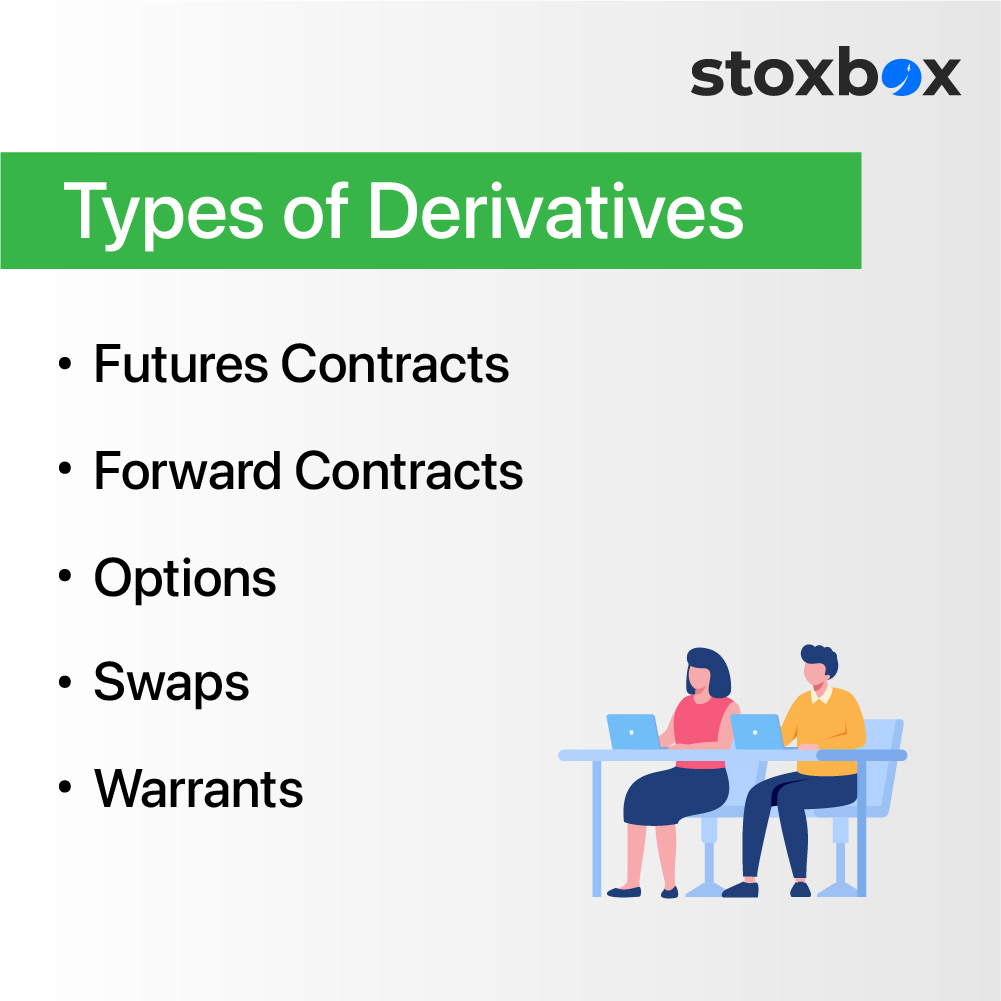
Investors usually leverage derivatives for two reasons – to mitigate risk via hedging, or assume risk in the expectation of potential returns in the future, also known as speculation. The most common types of derivatives include futures contracts, forward contracts, options, swaps, and warrants. Futures are pre-decided agreements between parties to buy or sell the underlying security at a fixed price, on a pre-determined date. Futures function on a simple logic, the buyer, and the seller, have different opinions on the potential price of the underlying security. While the buyer believes that, at the end of the pre-decided period, the actual price of the security will be higher than its current price, the seller believes differently.

While the forwards contract follows the same principle as futures, the forward contract is a private and customisable agreement between the two participants. It is traded over the counter and settled at the end of the maturity period. On the other hand, futures are standardised and trade on exchanges, with prices being settled every day, till the date of maturity.

Options made easy

Even as options contracts work on the same underlying principal as forwards and futures, with the buyer and seller agreeing to a pre-decided time and price, the key difference here is that the parties have the option of not sticking to the actual sale, at the time of delivery. There is no actual obligation to complete the trade.

Now, let us consider what are calls and puts in options trading. Under the call option, the buyer has the right, but not the obligation, to buy the security at the pre-decided price, before the decided date. This allows them the possibility to make a profit if the value of the security does rise in the future. On the other hand, the put option gives the seller the right, but not the obligation, to sell the security at the pre-decided price, any time before the maturity of the contract. If the actual price of the security falls before the maturity of the contract, the put option helps the seller limit losses by selling at the pre-decided higher price.

How to make profits trading in puts and calls

All You Need to Know About Option Trading and Option Strategies
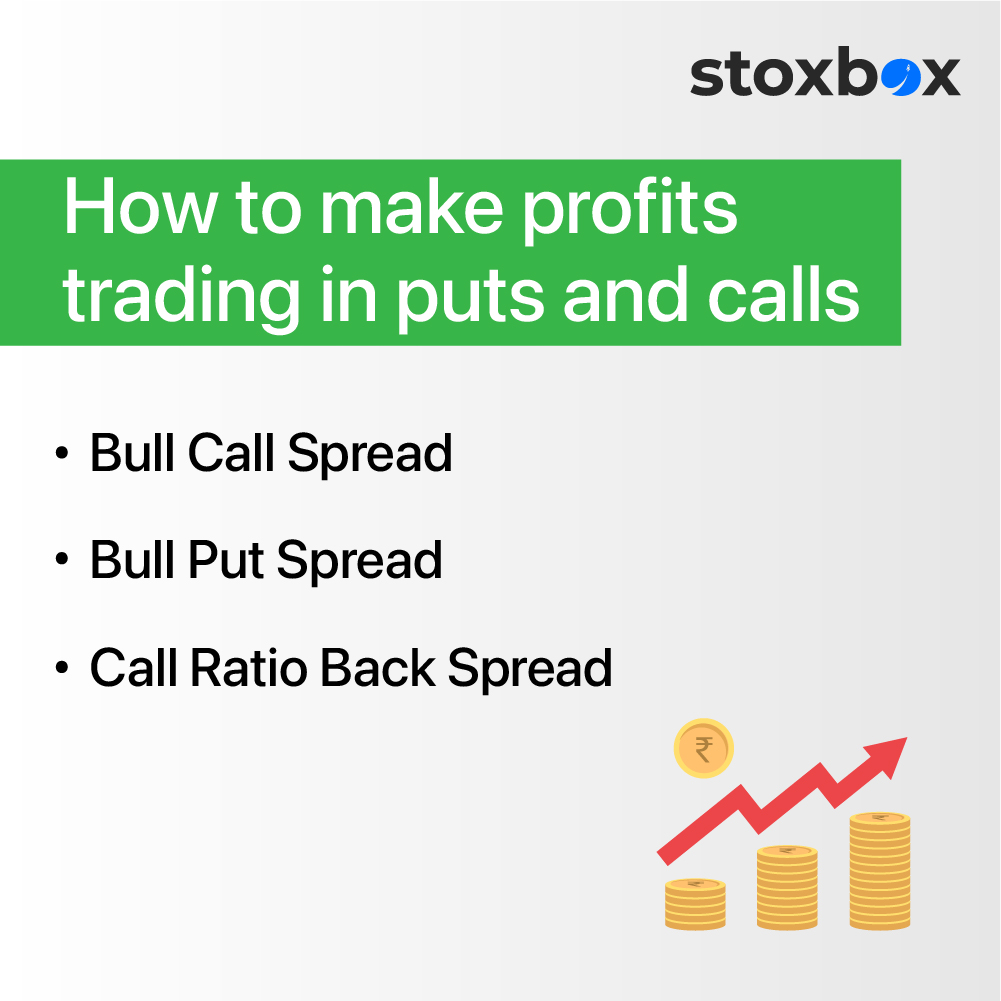
There are several popular option strategies being followed by traders. These include –
  •  Bull Call Spread: A bullish strategy which involves purchasing one At-The-Money (ATM) call option and selling the Out Of-The-Money call option, the bull spread call requires both options to have the same underlying security and the same maturity date. This strategy protects you when the prices drop but the profit is also curtailed proportionately, meaning that both profit and loss are capped. It is useful if you are not too bullish on the security, helping you make a profit if it does rise, but also ensuring you limit losses if it drops.
  • Bull Put Spread: If you are positive on the movement of the security, this strategy is for you. It is similar to the bull call spread, except that, here, you purchase put options. The rest of the metrics remain the same. This strategy will help you when you expect the security’s price to rise slightly, move sideways, or fall in a limited manner.
  • Call Ratio Back Spread: This is one of the simplest strategies you can use when you are strongly bullish on the security. Under this strategy, you can purchase two OTM call options and sell one ITM call option and it will help you make unprecedented profit if the prices do rise in the future. Further, even if the prices fall before the pre-decided date, you will still end up making some profit as you have the option to forego the loss-making trade.
Now that you know all about option trading and option strategies, you can start your journey by taking small risks and building your appetite in line with your experience.

Your Wealth-Building Journey Starts Here

You might also Like.

No posts found!

Option Trading Strategies with example

Benefits of investing for your future
  1. An Introduction to Call Option Fundamentals
    1. Call Option Basics learn the basic Definition with Examples
    2. Call option and put option understanding types of options
    3. What Is Call Option and How to Use It With Example
    4. Options Terminology The Master List of Options Trading Terminology
    5. Options Terms Key Options Trading Definitions
    6. Buy call option A Beginner’s Guide to Call Buying
    7. How to Calculate Profit on Call Option
    8. Selling Call Option What is Writing/Sell Call Options in Share Market?
    9. Call Option Payoff Exploring the Seller’s Perspective
    10. American vs European Options What is the Difference?
    11. Put Option A Guide for Traders
    12. put option example: Analysis of Bank Nifty and the Bearish Outlook
    13. Put option profit formula: P&L Analysis and Break-Even Point
    14. Put Option Selling strategies and Techniques for Profitable Trading
    15. Call and put option Summary Guide
    16. Option premium Understanding Fluctuations and Profit Potential in Options Trading
    17. Option Contract moneyness What It Is and How It Works
    18. option moneyness Understanding itm and otm
    19. option delta in option trading strategies
    20. delta in call and put Option Trading Strategies
    21. Option Greeks Delta vs spot price
    22. Delta Acceleration in option trading strategies
    23. Secrets of Option Greeks Delta in option trading strategies
    24. Delta as a Probability Tool: Assessing Option Profitability
    25. Gamma in option trading What Is Gamma in Investing and How Is It Used
    26. Derivatives: Exploring Delta and Gamma in Options Trading
    27. Option Gamma in options Greek
    28. Managing Risk in Options Trading: Exploring Delta, Gamma, and Position Sizing
    29. Understanding Gamma in Options Trading: Reactivity to Underlying Shifts and Strike Prices
    30. Mastering Option Greeks
    31. Time decay in options: Observing the Effect of Theta
    32. Put Option Selling: Strategies and Techniques for Profitable Trading
    33. How To Calculate Volatility on Excel
    34. Normal distribution in share market
    35. Volatility for practical trading applications
    36. Types of Volatility
    37. Vega in Option Greeks: The 4th Factors to Measure Risk
    38. Options Trading Greek Interactions
    39. Mastering Options Trading with the Greek Calculator
    40. Call and Put Option Guide
    41. Option Trading Strategies with example
    42. Physical Settlement in Option Trading
    43. Mark to Market (MTM) and Profit/Loss Calculation
Marketopedia / An Introduction to Call Option Fundamentals / Option Trading Strategies with example

Here are the 4 trades that I will discuss:

Apollo Tyres – Directional trade, inspired by Technical Analysis logic

Nifty – Delta neutral, leveraging the effect of Vega

Infosys – Delta neutral, leveraging the effect of Vega

Infosys – Directional trade, common sense fundamental approach

For each transaction I will evaluate both the good and bad aspects. Keep in mind, all images displayed here were provided by the traders and I simply formatted them for my needs.

So, let’s get started.

Apollo Tyres

A 27 year-old novice executed the trade, his initial ever foray into options trading.

His logic for the trade was that Apollo Tyres, which had been trading around Rs 485 per share, was in good shape and had undoubtedly seen a strong upswing, but he thought the rally would start to taper off due to its seeming lack of energy.

He might have concluded that looking at the last few candles, the trading range in the last three days had been dwindling.

He invested in 470 (OTM) Puts paying a premium of Rs 18.25 per lot on 28th September. The expiration date for the contract was 29th October. Here is an overview:

To gain a better understanding, I posed a few queries to the trader:

What drove your decision to trade options instead of futures?

Investing in futures carries a risk, particularly in this situation as swift reversals can occur and changes to the market-to-market value may be harsh if there is a sudden reversal

Given the time remaining until expiry, why did I select an option with a slightly out-of-the-money strike price rather than one with a much deeper OTM valuation?

Because of their lack of liquidity, equity options are best used with strikes at or near the ATM

What about stoploss?

The plan for this trade is to close it off if Apollo Tyres reaches a new high. This would prove that the current uptrend is still going strong, and thus my decision to take a contrarian short call was incorrect

What about target?

The equity is currently trending upwards, meaning it’s a great time to secure profits as soon as it seems reasonable. Reversals can be sudden, so there may be no point in keeping short trades open. Considering this, it might be beneficial to reverse the trade and purchase a call option

What about holding period?

I’m trading on the premise of value appreciation. Thus, I don’t plan to hold this until maturity. There’s plenty of time left before it expires, which means even a minimal equity price fall should result in a considerable rise in premium

Note – the QnA is reproduced in my own words, the idea here is to produce the gist and not the exact word to word conversation.

So after he bought Apollo Tyres PE, this is what happened the very next day:

Equity price fell to 478, and the premium went up to Rs 20.75. He had been accurate in his prediction that should the expiration date remain far away, a slight decrease in the equity rate would result in a substantial rise of the option premium. Content with Rs 2.50 gain (per lot), he chose to close his trade.

Looking back I guess this was probably a good move.

I respect the trader’s first-time options dealing. The clarity of their thought process is admirable and, were I in the same situation, I’d have gone about it differently:

From the chart analysis, it was evident that exhaustion had set in for the rally. Thus, I opted for selling call options instead of buying them. Doing so would not necessarily guarantee a sudden fall in equity prices but rather could lead to the equity entering a sideways movement which is more favourable for option sellers

I would use the normal distribution calculation to choose strikes, always keeping liquidity in mind

I planned on executing the trade (selling calls) in the 2nd half of the series to take advantage of time decay

When it comes to directional trading, I don’t generally care for the naked option; the lack of risk and reward visibility makes this approach unappealing. On the other hand, I may make an exception if I see a flag formation in my technical analysis—then I may initiate a naked long call trade:

Equities ought to have gone up roughly 5-10% in line with the preceding trend

It seems as though some profit taking is going on by weak hands, evidenced by the correction occurring whilst trade volume remains low

I find this a good setup to buy call options.

For those exploring equity investment opportunities through a stock broker or consulting with a financial advisor, understanding real-world case studies proves essential when navigating the stock market. Whether evaluating trading calls or utilising a stock screener to identify opportunities, comprehending how experienced traders approach directional trades with clear entry logic, exit strategies, and risk management enables better decision-making in your own options trading journey.

RBI News Play (Nifty Options)

A person from Delhi executed a Nifty Index options trade based on RBI’s monetary policy announcement. I found this trade to be structured and thoughtfully crafted.

Here is the background for this trade.

The Reserve Bank of India’s (RBI) monetary policy announcement was eagerly awaited by the market, with many poised to guess the decision that would be taken. It was generally expected that RBI would reduce the repo rate by 25 basis points.

RBI’s monetary policy is awaited with anticipation by market players, as it tends to be a major factor in influencing the direction of the stock market.

This trader has made a few observations about the current market situation. They take into account recent events and shifts in the market:

It is common to observe that the market does not follow any particular course in the days leading up to a statement, particularly 2 or 3 before it is made. This pattern is applicable for equities too—for instance just before their quarterly results are revealed

Prior to the announcement/event, there is generally an increase in the market’s volatility

Since the volatility skyrockets, both call and put option premiums experience a significant increase

I can’t truly confirm the accuracy his initial remarks, but it’s reasonable to accept the 2nd and 3rd.

In light of the RBI’s policy statement, coupled with a favourable time value and heightened volatility (see image below), he chose to write options on September 28th.

Nifty was sitting close to 24,850, so the 24,900 strike was the ATM option. The two options, 24,900 CE and PE, were trading at Rs 285 and Rs 248 respectively—attaining a total premium of Rs 533 from writing them both.

Here is the option chain showing the option prices.

After speaking with him, I will explain his plan of action in my own words so you can gain an understanding of it:

Why are you shorting 24,900 CE and 24,900 PE?

Since there is still some time left before expiry and volatility is elevated, I think that the options are costly and premiums are higher than normal. Eventually, when the volatility fades, I reckon that the cost of the options will drop as well, presenting a situation where I can repurchase both of them at a much lower cost

Why did you choose to short ATM option?

Given the likelihood that I will be placing market orders at the time of exit, it’s important to minimise any loss due to impact cost. To this end, ATM options were an obvious choice thanks to their lower impact costs

For how long do you plan to hold the trade?

Volatility typically reduces as we approach the announcement period. Through experience, I recommend taking action and closing the trade a few minutes prior to the official statement. The Reserve Bank of India is slated to make this declaration at 11:00 AM on September 29th; therefore, I anticipate squaring off the trade by 10:50 AM

What kind of profits do you expect for this trade?

I expect around 15-20 points profits per lot for this trade

What is your stop loss for this trade?

Volatility can make or break a trade, so it’s best to set your stop loss accordingly. This trade also has a built-in stop loss based on time—keeping in mind that you should always exit shortly before the RBI announcement is made

He initiated the trade based on his ideas. I was more positive about this one compared to the prior Apollo Tyres transaction, which I believe had a lot of good luck involved in it. This one seemed to make more sense.

He succeeded in finalising the trade just before the RBI declared their policy decision the next day, as was expected.

Here is the screenshot of the options chain:

As expected, the volatility slid and both options dropped in price. The 24,900 CE was trading at Rs 270 and the 24,900 PE at Rs 235, with a combined premium value of Rs 505. This overnight trade proved to be quite successful as he managed to gain Rs 28 for every lot.

Just to give you a perspective—this is what happened immediately after the news hit the market.

My opinion of this trade is that I generally agree with the concept of fluctuation heading up in the lead-up to large market occurrences. But these trades should be executed a few days prior and not merely 24 hours ahead.

All too often, traders and investors who partake in option trading around news announcements underestimate the impact of volatility on their trades. Despite the seemingly simple logic behind Long Straddles—i.e. making money in either direction—the market can remain range-bound due to a sudden change in volatility or have a muted reaction altogether. As such, it is critically important to factor in volatility when carrying out these trades, as simply buying both Call and Put options might not have the desired result.

When a news story is released, the markets usually react. If the news is positive, Call options will rise; however, more often than not the Put option premiums decrease at a faster rate than the Call option gains value. Consequently, you may lose more on Put options and gain less on Calls. This is why I think selling options before an event can be beneficial.

For those exploring equity investment opportunities through a stock broker or consulting with a financial advisor, understanding how to profit from event-driven volatility compression proves essential when navigating the stock market. Whether evaluating trading calls or utilising a stock screener to identify opportunities, comprehending how to structure option writing strategies around major announcements like RBI policy decisions enables profitable trades that capitalise on predictable volatility patterns and time decay dynamics.

TCS Q2 Results

This other Delhi-based trader executed a much better trade than the previous trader did. The outcome was more favourable.

TCS was due to announce their Q2 results on 12th October, and thus a trade was set up four days before the event. The goal being that whilst news would drive volatility up, the option could be bought back when the volatility had lowered. It was a well-crafted plan.

TCS was trading close to Rs 3,850 per share, so he decided to go ahead with the 3,850 strike (ATM).

Here is the snapshot at the time of initiating the trade:

On 8th October at approximately 10:35 AM, the 3,850 CE was priced at Rs 165 with an implied volatility of 42.15%, whilst the 3,850 PE traded at Rs 158 and its implied volatility was recorded as 49.5%. In total, Rs 323 was paid per lot.

I asked the same questions during the initial trade as before, and received very comparable answers. Thus, I shall not be posting a question and answer selection here.

The market anticipated TCS’s Q2 results would be fairly satisfactory; however, they ended up being even better than expected. Here are the details:

In the July-September quarter, TCS reported a net profit of Rs 11,342 crore, up 8.7% from the same period last year. Revenue saw a 7.6% surge to reach Rs 62,613 crore, whilst a 5.2% sequential increase exceeded the forecasted 3.5-4% growth.

The net profit in rupee terms increased by 8.7%, amounting to Rs 11,342 crore, whilst the revenue rose at a rate of 7.6% to Rs 62,613 crore compared to last year.

The declaration came in at 9:18 AM, three minutes after trade started, and the trader successfully finished their deal at the same time.

Here is the snapshot:

The 3,850 CE traded at Rs 185 with implied volatility dropping to 29.5%, and the 3,850 PE was sold at Rs 68 with its implied volatility slumping to 41.8%.

Take note: the Call option rose more slowly than the Put option fell, for a total premium of Rs 253 a lot. His reward was Rs 70 points per lot.

I’m confident this trader has some experience, which is clear from the trade’s construction. If I were to perform this trade, I would likely adopt a very similar approach.

TCS Q2 Aftermath (Fundamentals Based)

This trade was executed by a fellow Bangalorean whom I am personally acquainted with. His fundamental analysis skills are quite remarkable, and now he is exploring the possibilities of options trading—combining his knowledge with this new form of investing. It will be fascinating to observe where this journey takes him.

Here is the background to the trade:

TCS recently announced an impressive set of figures, however the equity on 12th Oct saw a 4.8% dip, with a further 1.2% drop the following day.

After further digging, he came to the conclusion that the dip in the equity was far greater than anticipated because of TCS reducing their revenue guidance. This was a sensible analysis on their part, but he felt that the market had already taken it into account. Nonetheless, the 6% decrease was still higher than what one might have predicted given all this information.

He was positive that the market had severely overreacted to the guidance, and had not taken into account the good aspects of the results.

He was convinced that, when both good and bad news were provided together, the market would always respond more strongly to the negative. This was demonstrated in TCS’ case.

He went long on a call option, expecting the market would eventually respond to the second quarter results.

He opted to acquire TCS’s 3,750 CE at Rs 82.50 which was slightly OTM. His plan was to keep the investment active until the 3,750 strike moved into ITM. He was ready to face a risk of Rs 38.50 on this venture, meaning that if the premium dipped to Rs 44, he would be closing the trade with a loss.

Once the transaction was completed, the equity recovered, allowing him to close the deal on 21st October.

Here is the snapshot:

He more than doubled his money on this trade. It was certainly a lucrative move!

Realising the logic behind the trade was built using comprehension of financial statements, business basics, and options theory is key.

In terms of this trade, I’m fairly confident in making naked trades. The entry was logical, however, the exit and stoploss weren’t. Due to the long expiry period, I would have risked with more OTM options.

For those exploring equity investment opportunities through a stock broker or consulting with a financial advisor, understanding how to profit from event-driven volatility and post-announcement overreactions proves essential when navigating the stock market. Whether evaluating trading calls or utilising a stock screener to identify opportunities, comprehending how to structure trades around earnings announcements and fundamental analysis enables more profitable options strategies that capitalise on both volatility changes and market sentiment shifts.


    captcha


    option trading strategies top 18 strategies every investor should know

    1. Learn about Option Strategies
      1. option trading strategies top 18 strategies every investor should know
      2. Bull call spread how Options Trading Strategy Works
      3. What is Bull Call Spread? How to Use Options Trading Strategy for Stocks and Indices
      4. Spreads in Finance A Comprehensive Guide to Mastering Options Trading Strategies
      5. Bull Put Spread Step-by-Step Guide How to Execute Options Trading Strategy with Examples
      6. Call Ratio Back Spread Options Trading Strategy: Explained with Examples
      7. Understanding Call Ratio Back Spread Strategy and the Importance of Time to Expiry and Volatility
      8. Bear Call Ladder Strategy: Tips to Improve Your Share Trading Success
      9. Synthetic Long and Arbitrage Strategies in Nifty Futures with Options
      10. Arbitrage options trading strategy with Examples from Fish Market to Share Market
      11. Bear Put Spread Navigating Bearish Markets to Limit Losses
      12. Bear Call Spread Why Calls can be a Better Choice than Puts
      13. Put Ratio Back Spread Options Trading Strategy to Profit from a Bearish Market
      14. Advanced Options Trading Strategies: Generalization, Delta, Strike Selection, and Effect of Volatility
      15. Long Straddle Options Trading Strategy Maximizing Profits in Any Market Direction
      16. Straddle Options Strategy Understanding Volatility and Overcoming Potential Risks
      17. Short Straddle Options Trading Strategy with examples
      18. Strangle vs Straddle: Which Options Trading Strategy is Better
      19. Long Strangles vs Short Strangles: Which Options Trading Strategy is Right for You
      20. Max Pain how to use options strategy With Examples
      21. Put Call Ratio (PCR) Analysis: How to Identify Bullish or Bearish Trends in the Market
      22. Iron Condor How to use Options Strategy With examples
      23. Everything about Max P&L and ROI and Logistics
    Marketopedia / Learn about Option Strategies / option trading strategies top 18 strategies every investor should know

    One thing I’ve seen in all the conversations I’ve had with options traders, both seasoned and new, is that most view trading options as a hit-or-miss proposition.

    When one begins an options trade, there is usually a sense of amusement, yet, many people are unaware of how detrimental this can be.

    There are close to 475 option strategies, but in this chapter, we will discuss only some strategies you should know to understand the markets or stocks and map them with the right option strategy. 

    Here are the strategies that we will discuss: 

    Bullish strategies:

    1.   Bull Call Spread 
    2.   Bull Put Spread 
    3.   Call Ratio Back Spread
    4.   Bear Call 
    5.   Ladder Call 
    6.   Butterfly Synthetic Call 
    7.   Straps


    Bearish Spreads

    1.   Bear Call Spread 
    2.   Bear Put Spread 
    3.   Bull Put Ladder 
    4.   Put Ratio Back spread 
    5.   Strip 
    6.   Synthetic Put

    Neutral Strategies

    1.   Long & Short Straddles 
    2.   Long & Short Strangles
    3.   Long & Short Iron Condor 
    4.   Long & Short Butterfly 
    5.   Box


    Along with the above points, we will also discuss Max Pain for option writing, i.e. some key observations and practical aspects, and Volatility Arbitrage employing Dynamic Delta hedging. 

    One options strategy will be covered in each chapter so there is clarity and understanding over the strategy. This indicates that this module will consist of around 20 chapters. However, each chapter will be brief. I’ll go over each strategy’s history, execution, payoff, breakeven point, and potentially the best strikes to make. 

    Please bear in mind that while I will describe all of these methods using the Nifty Index as a benchmark, you can apply the same principles to any stock option.

    The most crucial thing I want you to know is that this module cannot be considered as a Holy Grail. Nothing in the markets, including none of the tactics we discuss in this module, is a guaranteed way to make money. This lesson aims to examine a few straightforward but crucial tactics that, when used properly, can generate income. 

    Consider it this way: if you drive your car safely and well, you can utilise it to commute and ensure your family’s comfort. However, if you drive rashly, it could be dangerous for both you and anyone around you.

    Similarly, these tactics generate income when used properly, if not, they might damage your P&L (Profit & Loss). I am responsible for ensuring you comprehend these techniques (help you learn how to drive a car). I will also explain the ideal circumstances in which you should apply these techniques. 

    But you have the power to make it work for you; this depends on your discipline and how much you understand the market. Having said that, I feel that as you spend more ‘quality’ time in the markets, your application of methods will improve.

    Let’s now get started! 

    Technical Analysis, what is it?
    Consider this analogy. Imagine you are vacationing in a foreign country where everything, including the language, culture, weather, and food, is new to you. On day 1, you do the regular touristy activities, and by evening you are starving and craving food. You want to end your day by having a great dinner. You ask around for a good restaurant, and you are told about a vibrant food street close by. You decide to give it a try. To your surprise, the food street has 100s of vendors selling different varieties of food. Everything looks different and interesting. You are clueless as to what to eat for dinner. To add to your dilemma, you cannot ask around as you do not know the local language. So given all this, how will you decide on what to eat?
    Setting expectations
    Market participants often approach technical analysis as a quick and easy way to profit. On the contrary, technical analysis is anything but quick and easy. If done right, consistently generating profits is possible, but to get to that stage, one must put in the required effort to learn the technique. A trading catastrophe is bound to happen if you approach TA as a quick and easy way to make money in markets. When a trading debacle happens, more often than not, the blame is on technical analysis and not on the trader’s inability to efficiently apply Technical Analysis. Hence before you start delving deeper into technical analysis, it is important to set expectations on what can and cannot be achieved with technical analysis.
    1. Trades – TA is best used to identify short-term trades. Do not use TA to identify long-term investment opportunities. Long-term investment opportunities are best identified using fundamental analysis. Also, If you are a fundamental analyst, use TA to calibrate the entry and exit points.
    2. Return per trade – TA – based trades are usually short-term in nature. Do not expect huge returns within a short duration of time. The right way to use TA is to identify frequent short-term trading opportunities that can give you small but consistent profits.
    3. Holding Period – Trades based on technical analysis can last between a few minutes to a few weeks, usually not beyond that. We will explore this aspect when we discuss the topic of timeframes.
    4. Holding Period – Trades based on technical analysis can last between a few minutes to a few weeks, usually not beyond that. We will explore this aspect when we discuss the topic of timeframes.
    5. Risk ­– Often, traders initiate a trade for a certain reason; however, in case of an adverse movement in the stock, the trade starts to lose money. Usually, in such situations, traders hold on to their loss-making trade with the hope they can recover the loss. Remember, TA-based trades are short-term; if the trade goes bad, do remember to cut the losses and move on to identify the next opportunity.

      captcha